Pargo
Project
Returns Solution
My Role
Senior Product Designer
Industry
Last Mile Logistics
Timeline
2023
Overview
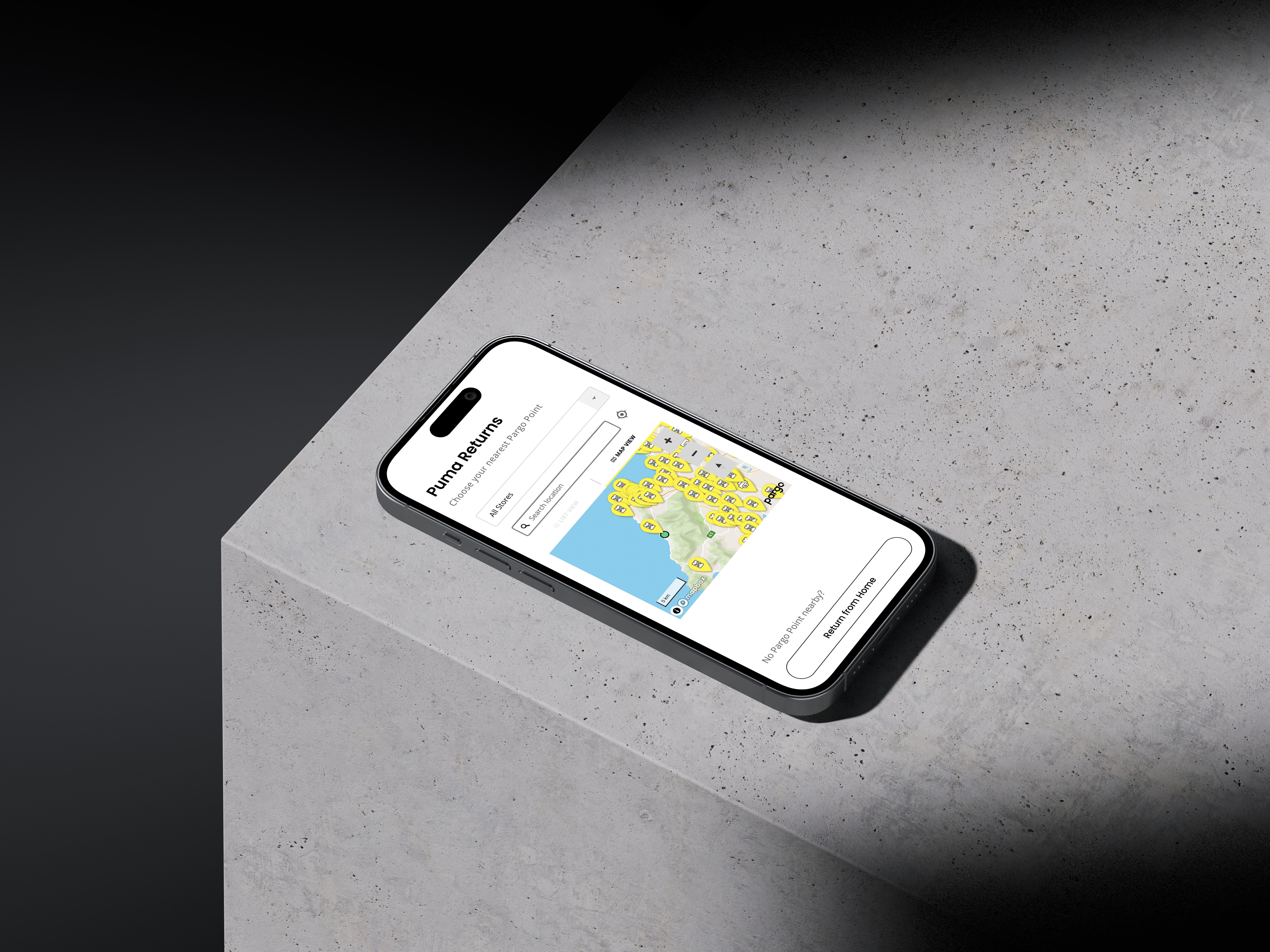
Pargo provides last-mile logistics in Africa, ensuring access for all. They have network points across South Africa and are expanding with a new returns process, leveraging their existing network for growth and revenue.
Goal
Allow users to easily initiate a return and drop it off at any Pargo Point location.
Problem
Users want to return a product they either bought online or in-store. Traditionally there was no returns process for people who came from townships and underprivileged areas. Users who do have access to returns don’t have time to wait at home all day for someone to pick it up. Therefore both types of users desire the flexibility to return the product when it best fits their schedule.
Interviews
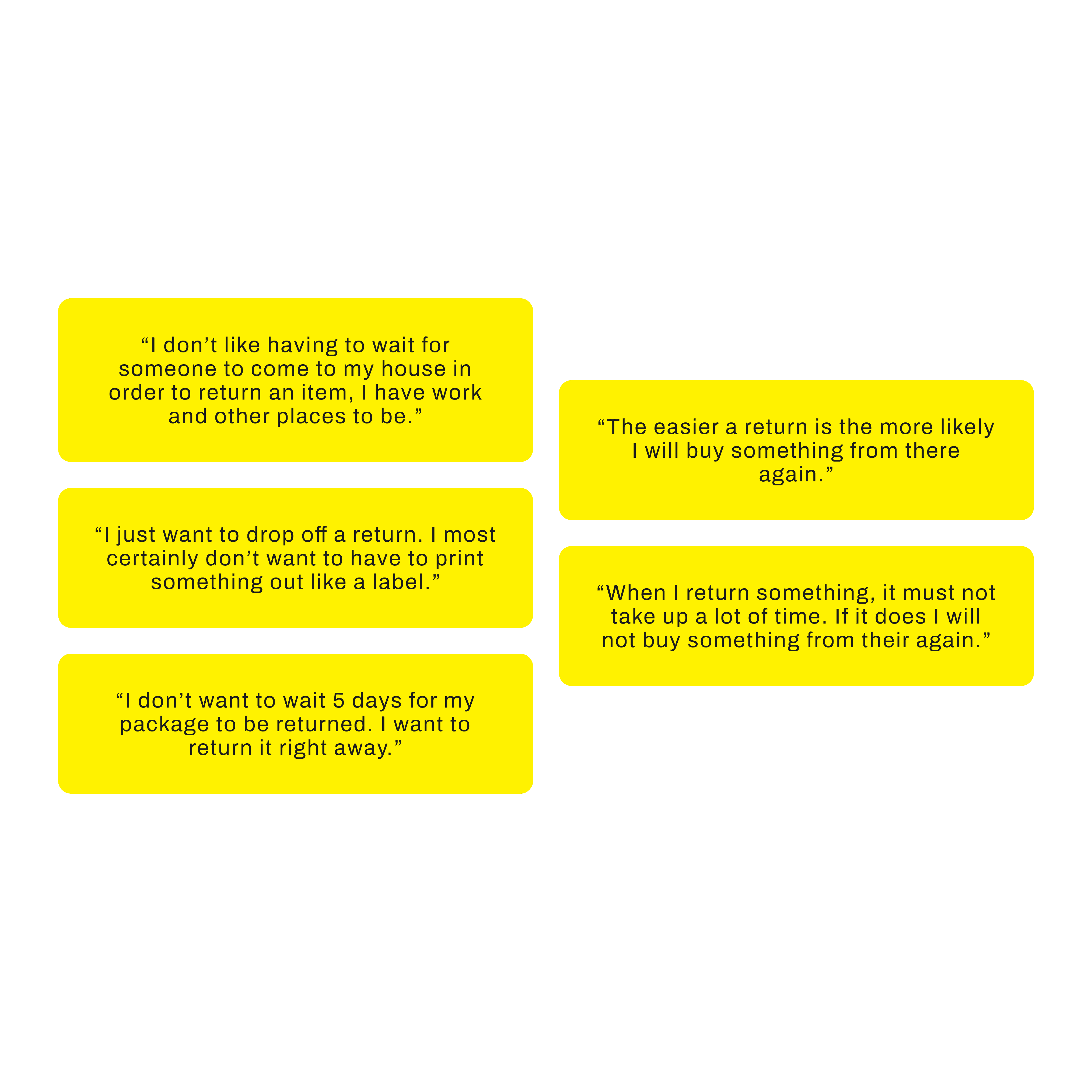
The first step was to conduct interviews to gain insights into various user preferences, pain points and any possible return habits. This research allowed us to identify what users value the most, such as a simple and quick return process that most likely required the least amount of steps. The people interviewed were a mix of users who returned more than 4 items a month and users who were new to returning items especially from townships.
Interviews
The first step was to conduct interviews to gain insights into various user preferences, pain points and any possible return habits. This research allowed us to identify what users value the most, such as a simple and quick return process that most likely required the least amount of steps. The people interviewed were a mix of users who returned more than 4 items a month and users who were new to returning items especially from townships.
Interviews
The first step was to conduct interviews to gain insights into various user preferences, pain points and any possible return habits. This research allowed us to identify what users value the most, such as a simple and quick return process that most likely required the least amount of steps. The people interviewed were a mix of users who returned more than 4 items a month and users who were new to returning items especially from townships.
Interviews
The first step was to conduct interviews to gain insights into various user preferences, pain points and any possible return habits. This research allowed us to identify what users value the most, such as a simple and quick return process that most likely required the least amount of steps. The people interviewed were a mix of users who returned more than 4 items a month and users who were new to returning items especially from townships.
Competitive Analysis
I also conducted a competitive analysis of existing return processes to benchmark strong patterns and identify common friction points. We looked at drop-off models, label-free experiences, and scan-based solutions. The goal wasn’t to copy competitors, but to understand what consistently works and where users struggle. This helped us design a return process flow that combined the best elements of each competitor while avoiding known pitfalls.

Competitive Analysis
I also conducted a competitive analysis of existing return processes to benchmark strong patterns and identify common friction points. We looked at drop-off models, label-free experiences, and scan-based solutions. The goal wasn’t to copy competitors, but to understand what consistently works and where users struggle. This helped us design a return process flow that combined the best elements of each competitor while avoiding known pitfalls.
Competitive Analysis
I also conducted a competitive analysis of existing return processes to benchmark strong patterns and identify common friction points. We looked at drop-off models, label-free experiences, and scan-based solutions. The goal wasn’t to copy competitors, but to understand what consistently works and where users struggle. This helped us design a return process flow that combined the best elements of each competitor while avoiding known pitfalls.
Competitive Analysis
I also conducted a competitive analysis of existing return processes to benchmark strong patterns and identify common friction points. We looked at drop-off models, label-free experiences, and scan-based solutions. The goal wasn’t to copy competitors, but to understand what consistently works and where users struggle. This helped us design a return process flow that combined the best elements of each competitor while avoiding known pitfalls.
Challenges
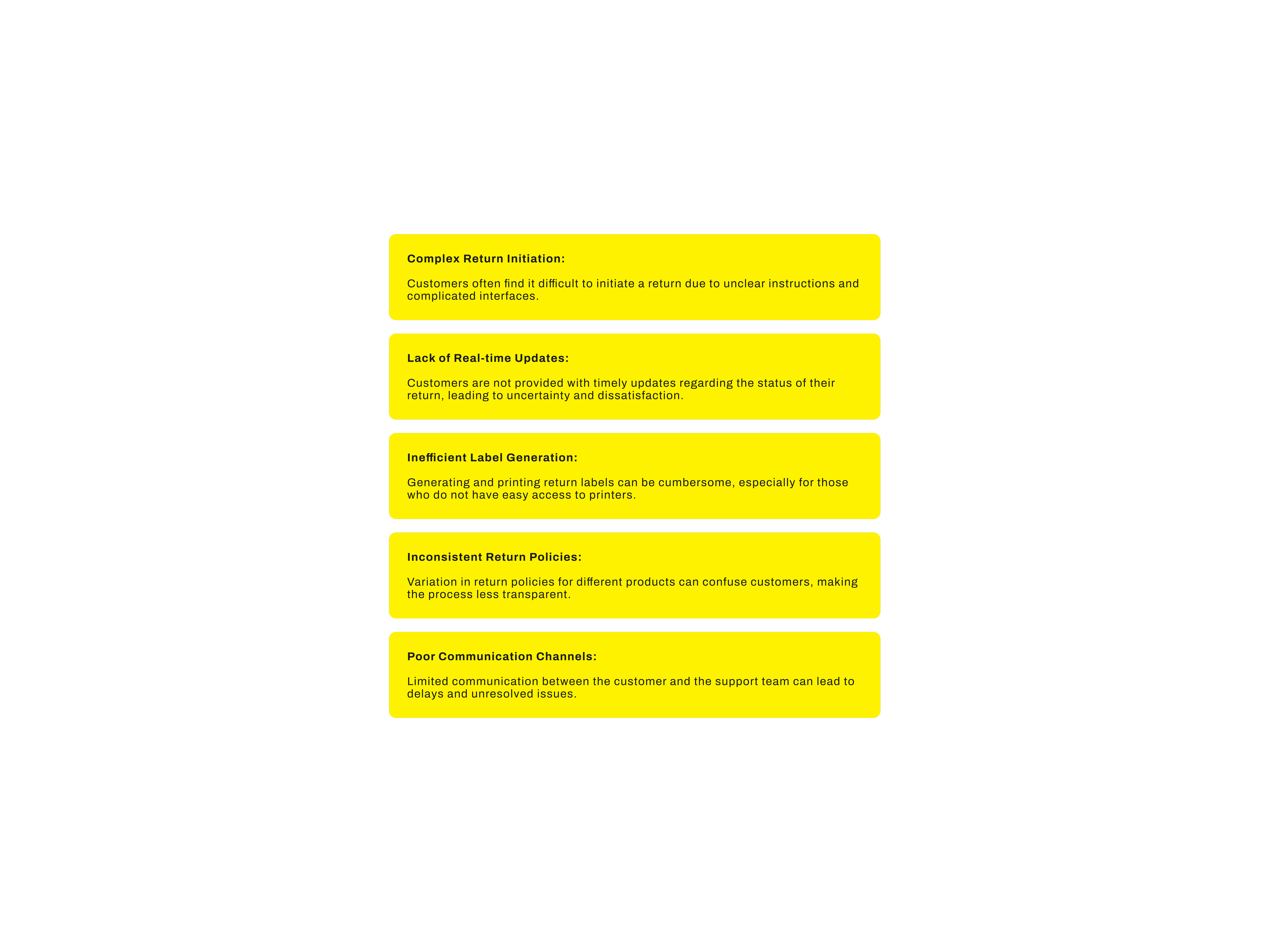
With all the research done some common challenges emerged:
The return instructions were often unclear.
Real time updates were non-existent.
Label printing was not always possible as not many people had access to them.
Inconsistent return policies among different return providers.
Customer support is often limited or non-existent leaving users frustrated.
Challenges
With all the research done some common challenges emerged:
The return instructions were often unclear.
Real time updates were non-existent.
Label printing was not always possible as not many people had access to them.
Inconsistent return policies among different return providers.
Customer support is often limited or non-existent leaving users frustrated.
Challenges
With all the research done some common challenges emerged:
The return instructions were often unclear.
Real time updates were non-existent.
Label printing was not always possible as not many people had access to them.
Inconsistent return policies among different return providers.
Customer support is often limited or non-existent leaving users frustrated.
Challenges
With all the research done some common challenges emerged:
The return instructions were often unclear.
Real time updates were non-existent.
Label printing was not always possible as not many people had access to them.
Inconsistent return policies among different return providers.
Customer support is often limited or non-existent leaving users frustrated.
User Journey
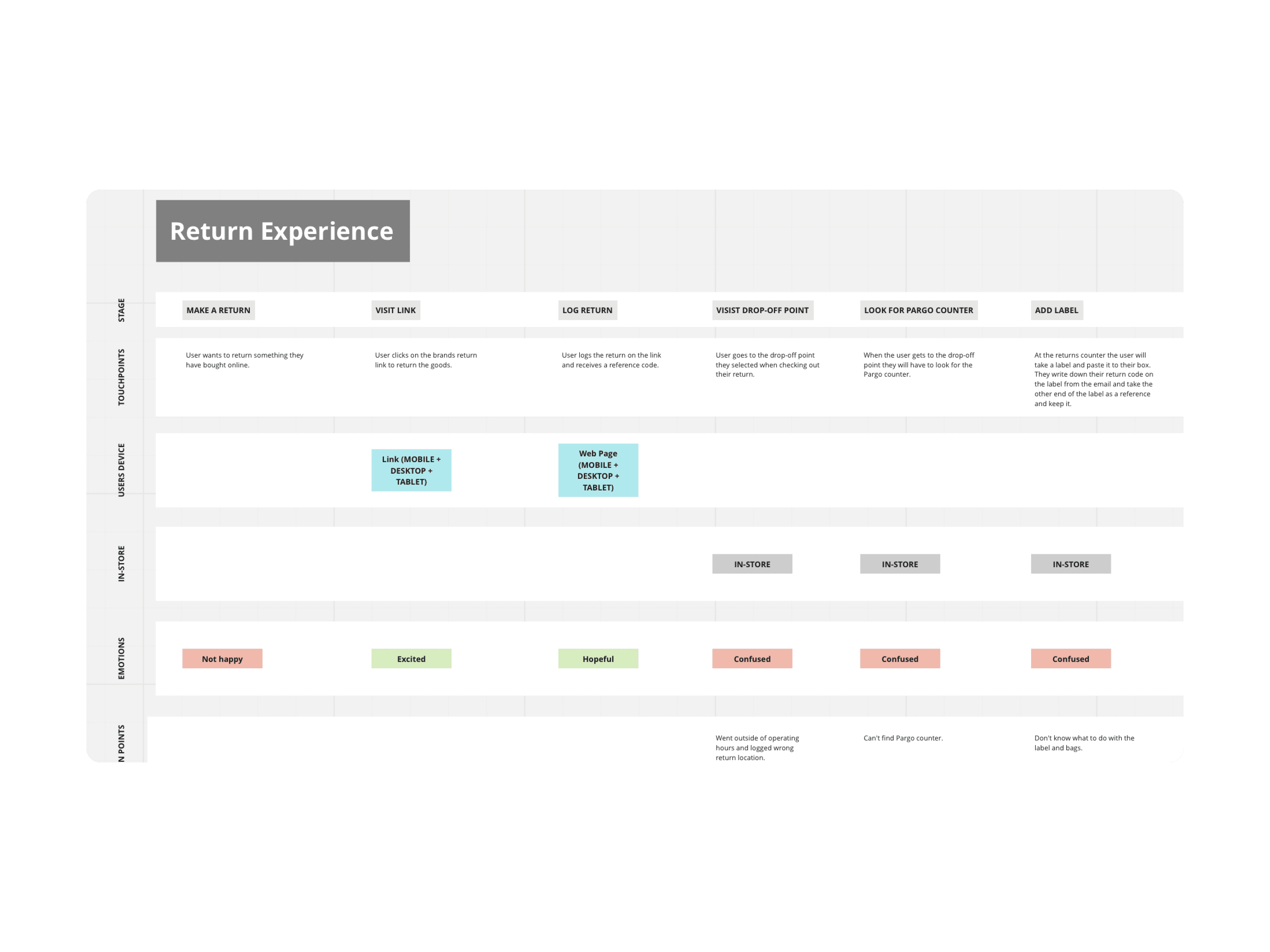
Next, I created a user journey map to visualise the end-to-end experience. This highlighted not just functional gaps but emotional friction, moments where users felt confusion, hesitation, or uncertainty. Journey mapping also aligned the team around where the process truly broke down and revealed opportunities for simplification, automation, and clearer communication. This was because there were multiple moving parts, not just a simple interaction with a screen but also having to deal with people at a drop-off point, packing the return a specific away and dropping it off at a specific location.
User Journey
Next, I created a user journey map to visualise the end-to-end experience. This highlighted not just functional gaps but emotional friction, moments where users felt confusion, hesitation, or uncertainty. Journey mapping also aligned the team around where the process truly broke down and revealed opportunities for simplification, automation, and clearer communication. This was because there were multiple moving parts, not just a simple interaction with a screen but also having to deal with people at a drop-off point, packing the return a specific away and dropping it off at a specific location.
User Journey
Next, I created a user journey map to visualise the end-to-end experience. This highlighted not just functional gaps but emotional friction, moments where users felt confusion, hesitation, or uncertainty. Journey mapping also aligned the team around where the process truly broke down and revealed opportunities for simplification, automation, and clearer communication. This was because there were multiple moving parts, not just a simple interaction with a screen but also having to deal with people at a drop-off point, packing the return a specific away and dropping it off at a specific location.
User Journey
Next, I created a user journey map to visualise the end-to-end experience. This highlighted not just functional gaps but emotional friction, moments where users felt confusion, hesitation, or uncertainty. Journey mapping also aligned the team around where the process truly broke down and revealed opportunities for simplification, automation, and clearer communication. This was because there were multiple moving parts, not just a simple interaction with a screen but also having to deal with people at a drop-off point, packing the return a specific away and dropping it off at a specific location.
Wireframes
With the journey mapped, I created wireframes to define the structure of each return path. These addressed the core pain points we discovered — unclear steps, lack of updates, reliance on printed labels. I also had to account for constraints like varying retailer policies and what each Pargo Point was operationally capable of handling. The wireframes let us validate the logic early before investing in high-fidelity design. These also helped me align with engineering on what they expected and needed from me.

Wireframes
With the journey mapped, I created wireframes to define the structure of each return path. These addressed the core pain points we discovered — unclear steps, lack of updates, reliance on printed labels. I also had to account for constraints like varying retailer policies and what each Pargo Point was operationally capable of handling. The wireframes let us validate the logic early before investing in high-fidelity design. These also helped me align with engineering on what they expected and needed from me.
Wireframes
With the journey mapped, I created wireframes to define the structure of each return path. These addressed the core pain points we discovered — unclear steps, lack of updates, reliance on printed labels. I also had to account for constraints like varying retailer policies and what each Pargo Point was operationally capable of handling. The wireframes let us validate the logic early before investing in high-fidelity design. These also helped me align with engineering on what they expected and needed from me.
Wireframes
With the journey mapped, I created wireframes to define the structure of each return path. These addressed the core pain points we discovered — unclear steps, lack of updates, reliance on printed labels. I also had to account for constraints like varying retailer policies and what each Pargo Point was operationally capable of handling. The wireframes let us validate the logic early before investing in high-fidelity design. These also helped me align with engineering on what they expected and needed from me.
Testing
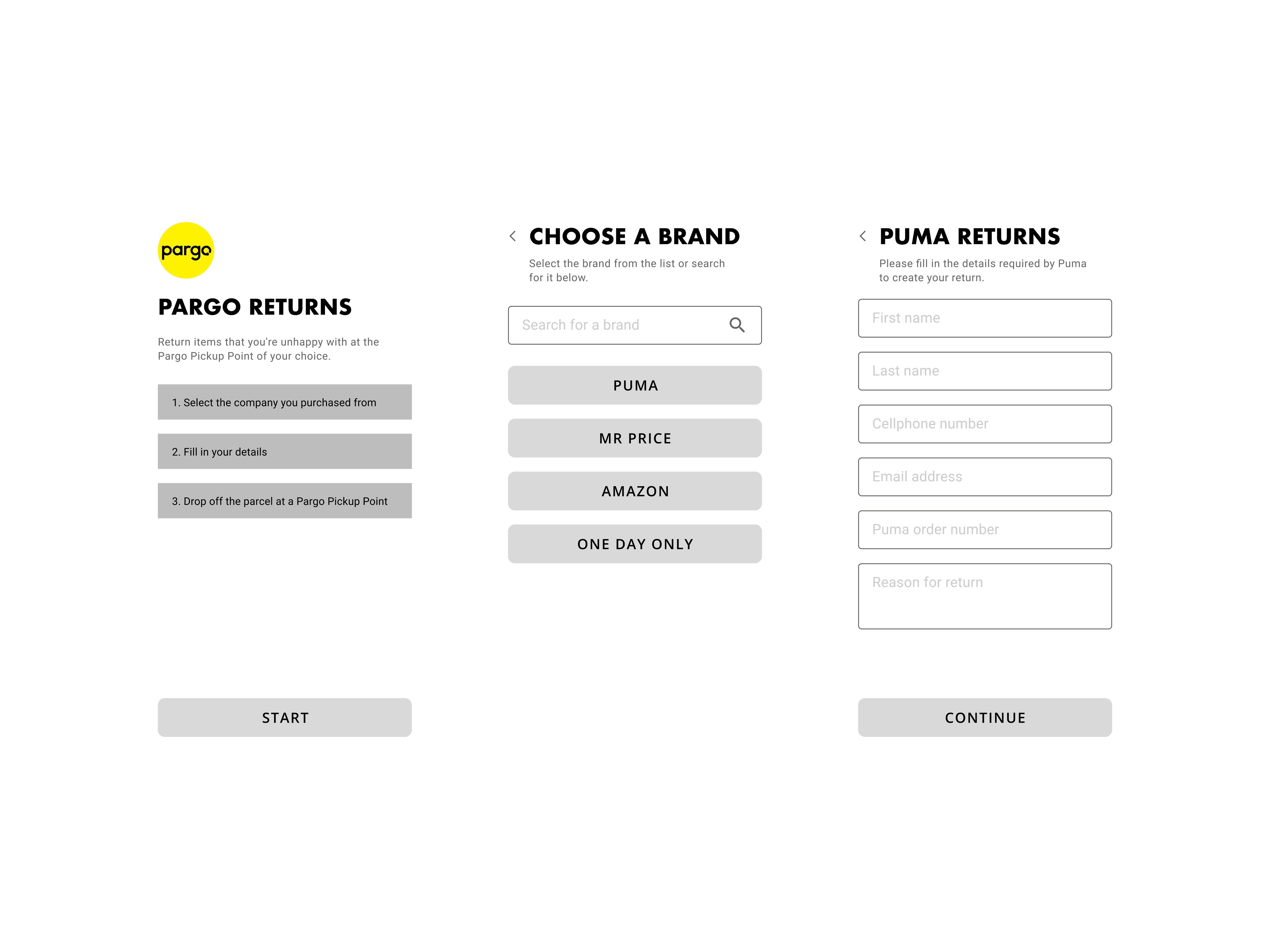
After the wireframe was designed a mid-fidelity prototype was designed in order to do some user testing. The scenario given was a user who of bought a pair of Puma shoes online but received the wrong size when they were delivered. They had to log the return and follow the prompts afterwards.
Testing
After the wireframe was designed a mid-fidelity prototype was designed in order to do some user testing. The scenario given was a user who of bought a pair of Puma shoes online but received the wrong size when they were delivered. They had to log the return and follow the prompts afterwards.
Testing
After the wireframe was designed a mid-fidelity prototype was designed in order to do some user testing. The scenario given was a user who of bought a pair of Puma shoes online but received the wrong size when they were delivered. They had to log the return and follow the prompts afterwards.
Testing
After the wireframe was designed a mid-fidelity prototype was designed in order to do some user testing. The scenario given was a user who of bought a pair of Puma shoes online but received the wrong size when they were delivered. They had to log the return and follow the prompts afterwards.
Feedback
After testing, I also sent out surveys to capture more structured feedback. Some of the feedback we received was things like, We don’t require an extra info field, I can't print a return label, reduce overwhelming brand pages, and clarify what happens next. This highlighted the problem the users had which was that it wasn't just a singular mobile experience that we had to get right but a holistic end-to-end experience. We then prioritized the findings and took the possible changes into account.

Feedback
After testing, I also sent out surveys to capture more structured feedback. Some of the feedback we received was things like, We don’t require an extra info field, I can't print a return label, reduce overwhelming brand pages, and clarify what happens next. This highlighted the problem the users had which was that it wasn't just a singular mobile experience that we had to get right but a holistic end-to-end experience. We then prioritized the findings and took the possible changes into account.
Feedback
After testing, I also sent out surveys to capture more structured feedback. Some of the feedback we received was things like, We don’t require an extra info field, I can't print a return label, reduce overwhelming brand pages, and clarify what happens next. This highlighted the problem the users had which was that it wasn't just a singular mobile experience that we had to get right but a holistic end-to-end experience. We then prioritized the findings and took the possible changes into account.
Feedback
After testing, I also sent out surveys to capture more structured feedback. Some of the feedback we received was things like, We don’t require an extra info field, I can't print a return label, reduce overwhelming brand pages, and clarify what happens next. This highlighted the problem the users had which was that it wasn't just a singular mobile experience that we had to get right but a holistic end-to-end experience. We then prioritized the findings and took the possible changes into account.
Communications
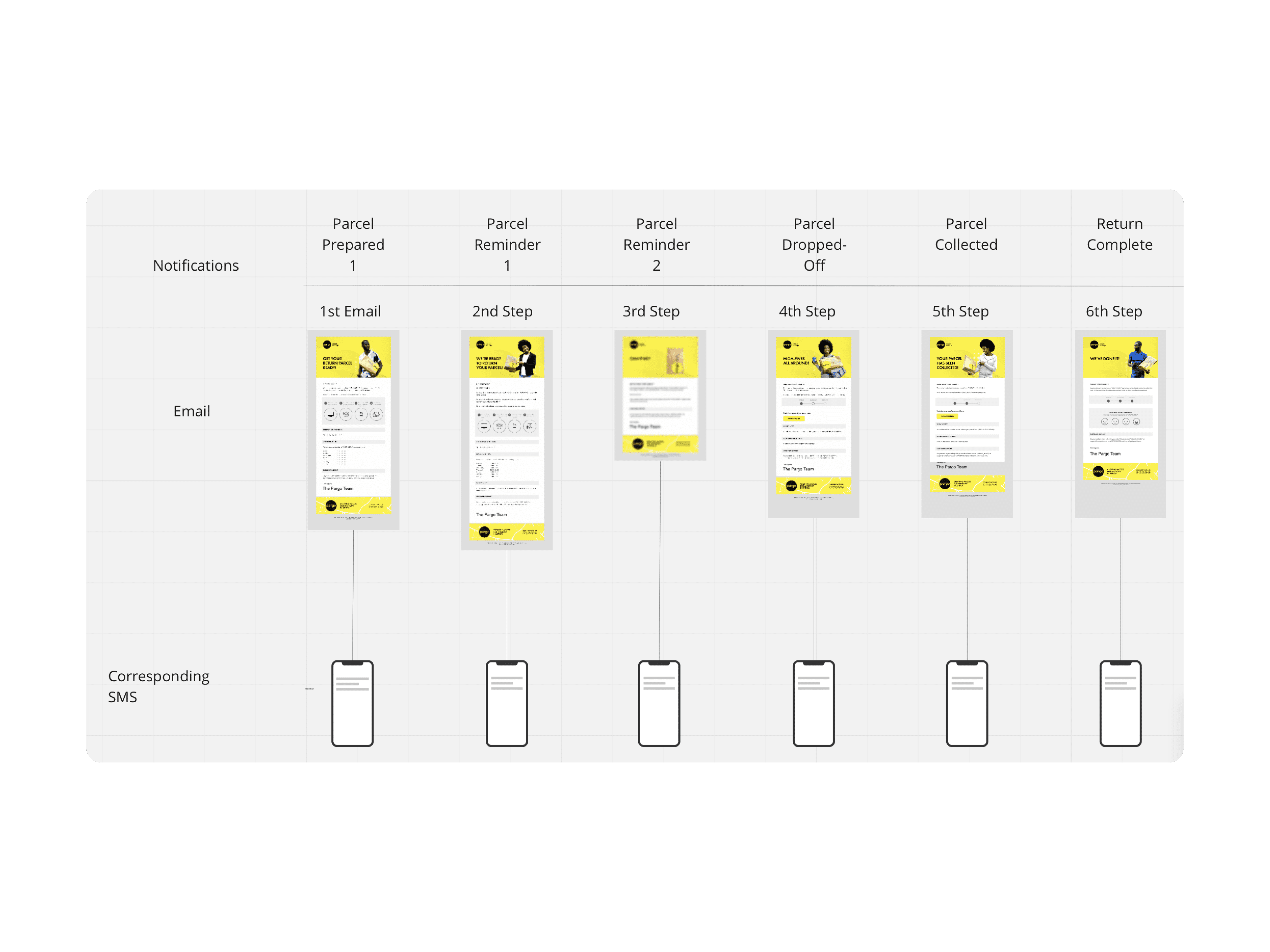
One of the biggest insights which was unexpected at the beginning of this project was that users didn’t always know what to expect after each step and how important communications would be. We addressed this by strengthening communication across the entire flow. We added clear, instructional next steps and sent timely updates via email and SMS. Because uncertainty was one of the biggest friction points, improving communication became a high-priority iteration.
Communications
One of the biggest insights which was unexpected at the beginning of this project was that users didn’t always know what to expect after each step and how important communications would be. We addressed this by strengthening communication across the entire flow. We added clear, instructional next steps and sent timely updates via email and SMS. Because uncertainty was one of the biggest friction points, improving communication became a high-priority iteration.
Communications
One of the biggest insights which was unexpected at the beginning of this project was that users didn’t always know what to expect after each step and how important communications would be. We addressed this by strengthening communication across the entire flow. We added clear, instructional next steps and sent timely updates via email and SMS. Because uncertainty was one of the biggest friction points, improving communication became a high-priority iteration.
Communications
One of the biggest insights which was unexpected at the beginning of this project was that users didn’t always know what to expect after each step and how important communications would be. We addressed this by strengthening communication across the entire flow. We added clear, instructional next steps and sent timely updates via email and SMS. Because uncertainty was one of the biggest friction points, improving communication became a high-priority iteration.
Final Design & Changes
Once all changes were done we could clearly see by the feedback that users could effectively generate and complete a successful Return.
The Changes were
Adding “Next Steps” alleviated the pain point of not knowing what to do next.
Removing additional info fields
Making most available drop-off points paperless - so a return can be done with a QR/drop-off code or a label.
Most importantly have the improved communications in place


Final Design & Changes
Once all changes were done we could clearly see by the feedback that users could effectively generate and complete a successful Return.
The Changes were
Adding “Next Steps” alleviated the pain point of not knowing what to do next.
Removing additional info fields
Making most available drop-off points paperless - so a return can be done with a QR/drop-off code or a label.
Most importantly have the improved communications in place
Final Design & Changes
Once all changes were done we could clearly see by the feedback that users could effectively generate and complete a successful Return.
The Changes were
Adding “Next Steps” alleviated the pain point of not knowing what to do next.
Removing additional info fields
Making most available drop-off points paperless - so a return can be done with a QR/drop-off code or a label.
Most importantly have the improved communications in place
Final Design & Changes
Once all changes were done we could clearly see by the feedback that users could effectively generate and complete a successful Return.
The Changes were
Adding “Next Steps” alleviated the pain point of not knowing what to do next.
Removing additional info fields
Making most available drop-off points paperless - so a return can be done with a QR/drop-off code or a label.
Most importantly have the improved communications in place
Monitoring with HotJar
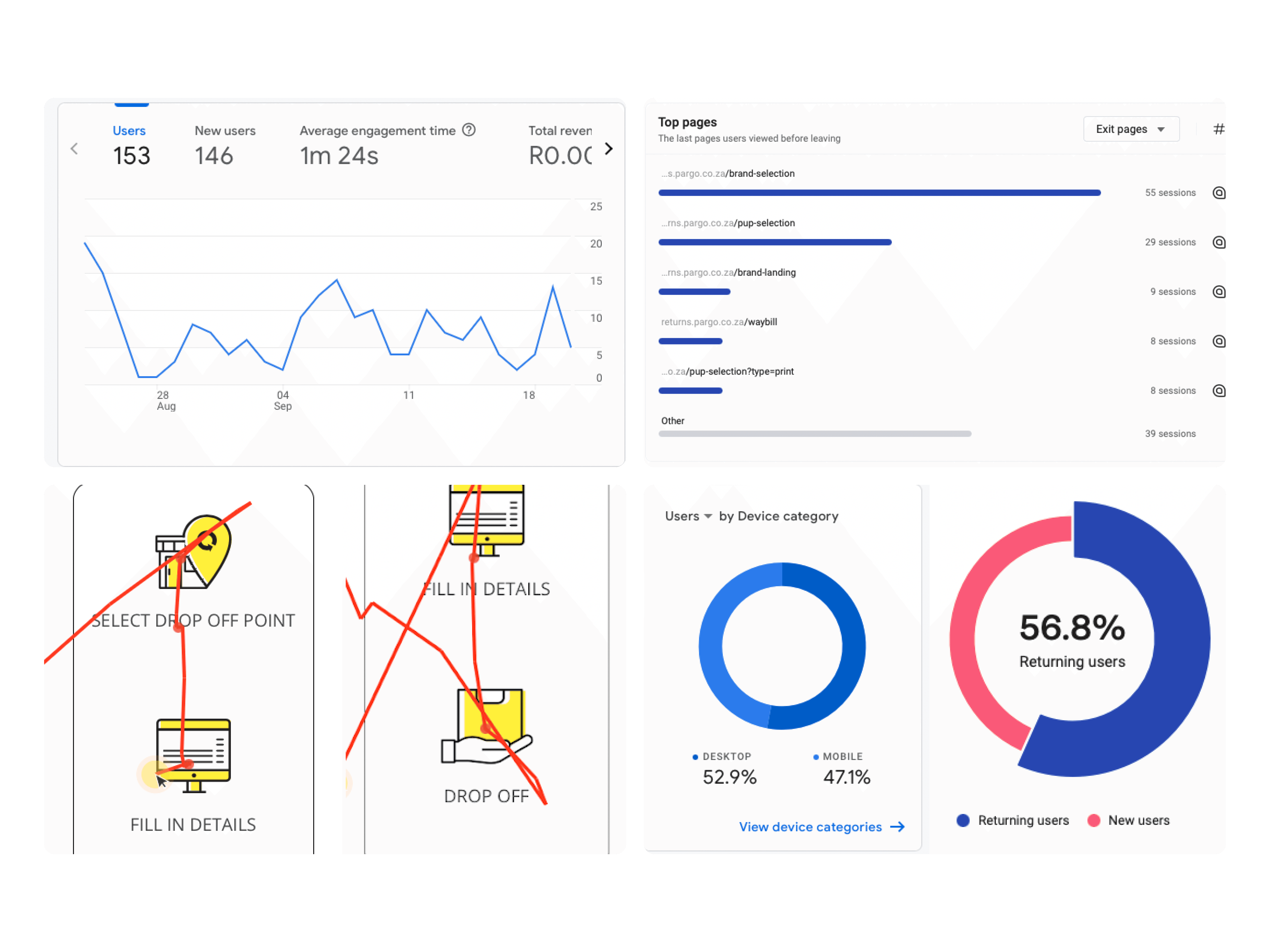
As we know the design is an ongoing process. With the implementation of HotJar for the live product, we were able to track and better understand user behaviour. And when necessary make improvements to the experience.
Monitoring with HotJar
As we know the design is an ongoing process. With the implementation of HotJar for the live product, we were able to track and better understand user behaviour. And when necessary make improvements to the experience.
Monitoring with HotJar
As we know the design is an ongoing process. With the implementation of HotJar for the live product, we were able to track and better understand user behaviour. And when necessary make improvements to the experience.
Monitoring with HotJar
As we know the design is an ongoing process. With the implementation of HotJar for the live product, we were able to track and better understand user behaviour. And when necessary make improvements to the experience.
Impact
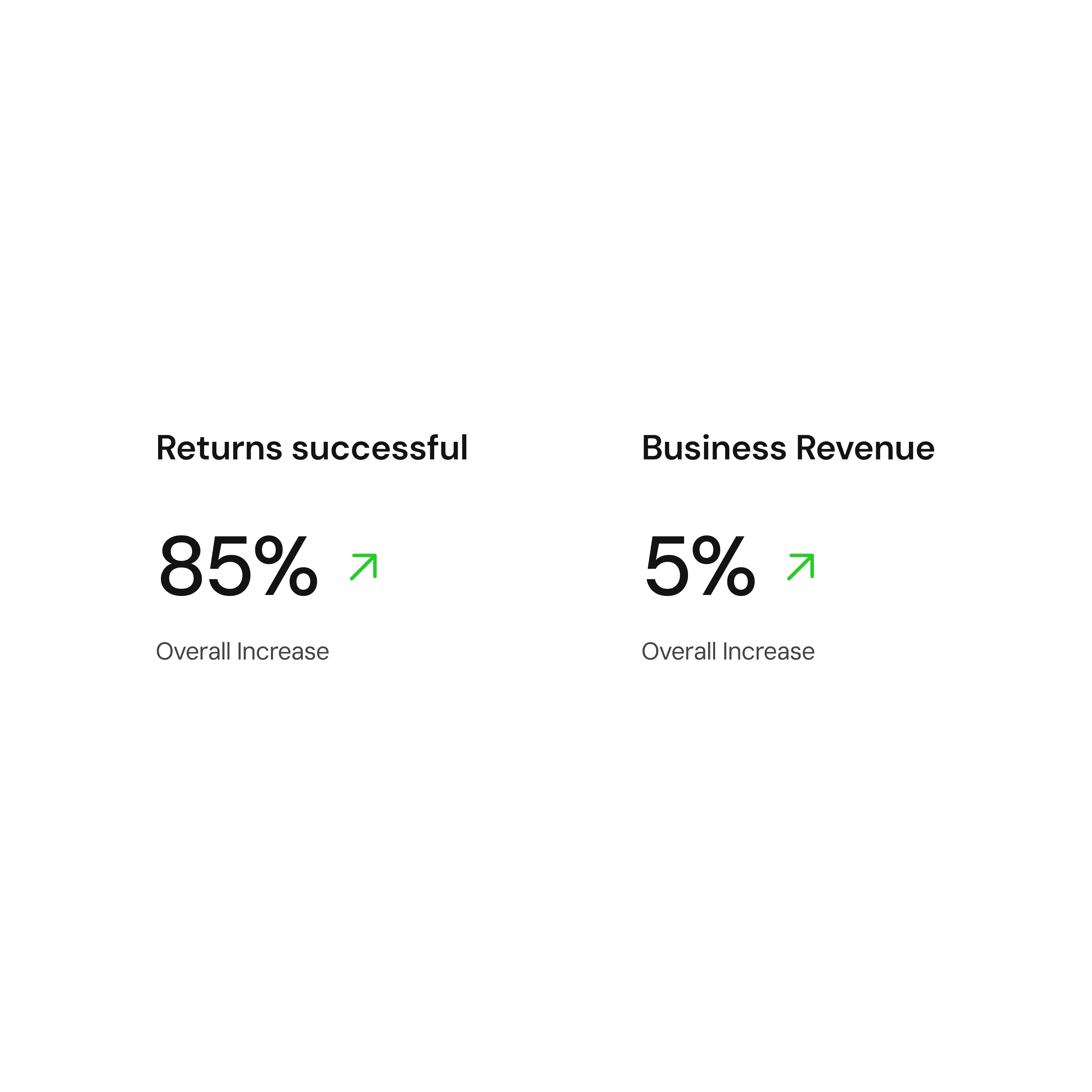
The final design made the returns process simple and intuitive. As a new product we saw returns hit a success rate of 85% in the first Q1 by measuring the success rate from creating a return to the service provider actually receiving the return. An increase in business revenue of a significant 5% was achieved through the introduction of an entirely new revenue stream. This increase was measured by the amount of income generated by the product as a new offering. The revenue was driven by companies that facilitated returns, which paid fees to enhance the overall user returns experience.
Impact
The final design made the returns process simple and intuitive. As a new product we saw returns hit a success rate of 85% in the first Q1 by measuring the success rate from creating a return to the service provider actually receiving the return. An increase in business revenue of a significant 5% was achieved through the introduction of an entirely new revenue stream. This increase was measured by the amount of income generated by the product as a new offering. The revenue was driven by companies that facilitated returns, which paid fees to enhance the overall user returns experience.
Impact
The final design made the returns process simple and intuitive. As a new product we saw returns hit a success rate of 85% in the first Q1 by measuring the success rate from creating a return to the service provider actually receiving the return. An increase in business revenue of a significant 5% was achieved through the introduction of an entirely new revenue stream. This increase was measured by the amount of income generated by the product as a new offering. The revenue was driven by companies that facilitated returns, which paid fees to enhance the overall user returns experience.
Impact
The final design made the returns process simple and intuitive. As a new product we saw returns hit a success rate of 85% in the first Q1 by measuring the success rate from creating a return to the service provider actually receiving the return. An increase in business revenue of a significant 5% was achieved through the introduction of an entirely new revenue stream. This increase was measured by the amount of income generated by the product as a new offering. The revenue was driven by companies that facilitated returns, which paid fees to enhance the overall user returns experience.


